
I Think You Should Heave
On bricks, behavioral interventions, and basketball erasure.
On January 15, NBA players attempted a combined 16 halfcourt shots to tie a single-night heave record. Each shot was fired as time expired. Some flew over the backboard. Some fell a dozen feet short. None went in, or even touched iron. Beautiful bricks, each in their own way.
Rookies, hall-of-famers, and even twins, were part of this Historic Heavening, featuring 945 feet of heaves, from Los Angeles all the way to Germany.
Yet, there is no official documentation of these 16 shots. On the official NBA box score, Stephen Curry’s 46-footer — close enough to elicit a collective “ahhh” from Chase Center — is nowhere to be found. Santi Aldama airballed two halfcourt shots yet is credited with a perfect 4-4 from three-point range. Amen Thompson’s full-court prayer is not on the Rockets-Thunder play-by-play. On NBA box scores, these bricks do not exist.
That’s because a new NBA rule, effective this season, declares that missed end-of-quarter shots from 36-plus feet are recorded as team misses rather than individual ones. In other words, these heaves don’t count.
This new rule was designed to encourage professional basketball players to shoot more basketballs, and it’s working. NBA players are heaving more — and deeper — than ever. Leaguewide attempts went up 61% while the average heave increased eight feet from last season.
We’re blessed with more glorious moments like this, this, and this. The Heavolution is here and it’s spectacular.
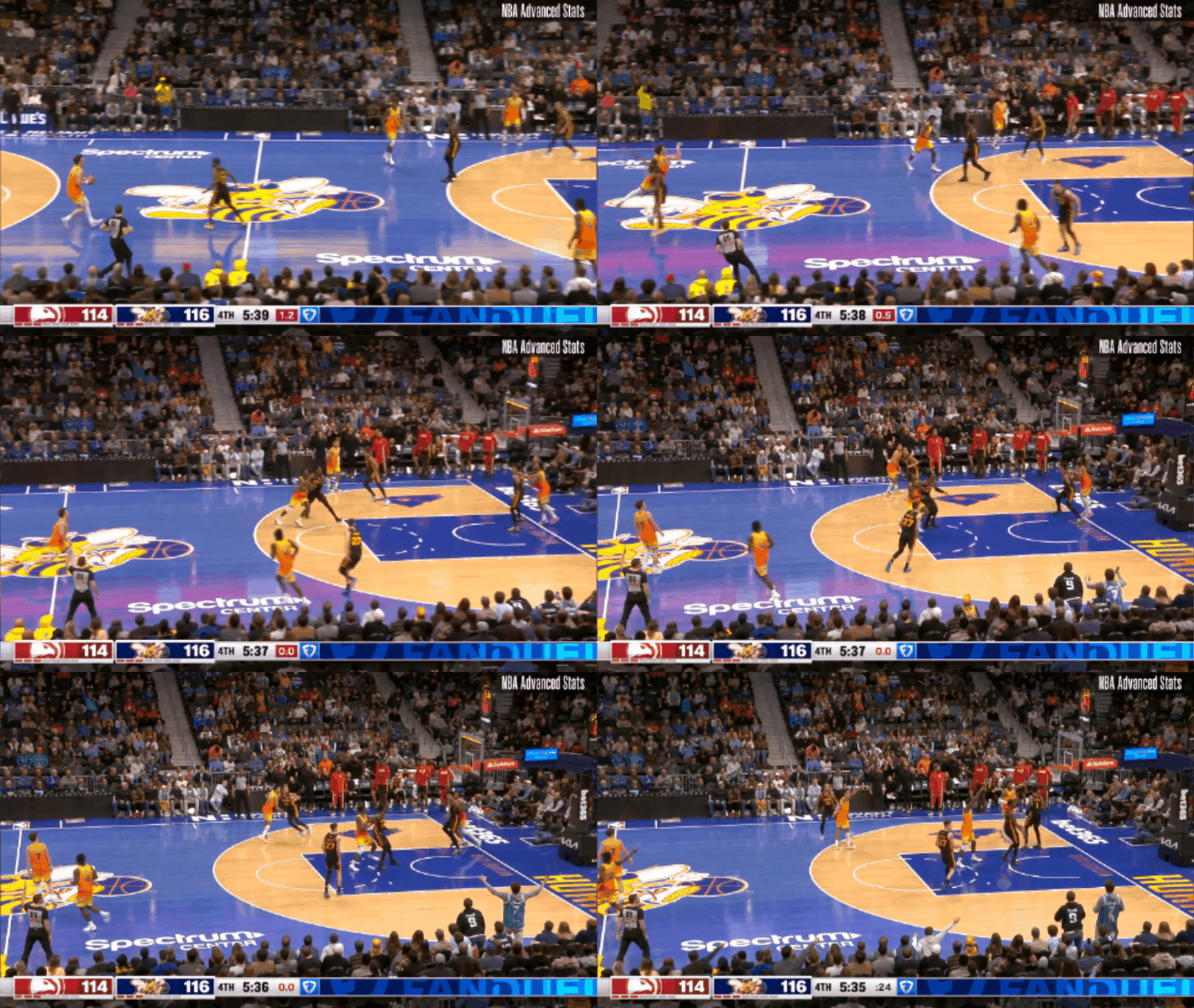
But the new rule comes at a cost. Players are firing away, because there’s no reason not to. Stat sheets are being sanitized and perfect bricks are being wiped from history. This is basketball erasure, and I won’t stand for it.
🧱🧱 🏀 🧱🧱
Built from 16,000 Bricks
Last summer, the NBA announced a rule change allowing players to take halfcourt shots without hurting their shooting percentages. End-of-quarter attempts from at least 36 feet away now count as team shots when they don’t go in.
The more heaves the merrier, right? That’s not how I saw it. Like analysts Zach Lowe and Richard Jefferson, I thought the rule bailed out the cowards.
“Loser shit,” I texted the group chat, sitting on my porch, staring at my lawn. “Just add four more playoff teams while you’re at it.”
With my righteous indignation unreciprocated, I did what any well-adjusted person would do: spent three months building the NBA heave database.
My goal: to document what the NBA decided is not worth documenting. To remember the true Heave Heroes, those who sacrificed their percentages for the love of the shot. And to ensure that present-day heaves would not be stricken from the record.
The heave database is built from 16,000 bricks, each with a story to tell. The brick throwers are a hodgepodge of “Remember That Guys.” Andre Miller, famous for never missing games, also never turned down a heave—fully aware of what it was doing to his field goal percentage. There’s Stephen Curry of course. Jamal Crawford. Steve Blake. Earl Watson. Flip Murray.
You’re reminded that Ben Simmons, infamously afraid of normal three-pointers (and layups), was actually heave-happy when he entered the league. Meanwhile, stars like Kevin Durant, James Harden, and LeBron James often refuse them—Durant even confessed to protecting his field goal percentage.
And let’s not forget about dry heavers like DeMar DeRozan, who keep on firing. Because that 65th attempt is finally going in.
But the past is the past. This is about the present. It’s about the numbers that the league and its players don’t want you to see.
🧱🧱 🏀 🧱🧱
Heave Retrieval
The NBA Heave Report database is sourced largely from the GitHub of a Western Conference analytics coordinator. The raw files contain every shot from every game spanning 2003 through last season. In total: 5 million shot attempts — coordinates, distance, time, result, etc.
But the real challenge was unlocking the 2025-26 heave data. That’s because the NBA is hiding it.
There’s no ‘heave’ category on NBA.com or ESPN.com. Basketball Reference’s half-court stat excludes Team heaves; Jamal Murray leads with 3 attempts, all makes, because his misses aren’t tracked. Post-rule change heave data, I realized, was nowhere publicly available.
At least not yet.
For days I searched for solutions, even contemplating a subscription service like Synergy or Second Spectrum. Then after digging through the Dark Basketball Web, I found what I needed: APIs.
Turns out, behind each NBA box score is an API listing full play-by-play data—shots, fouls, assists. Who did what, when, where, and how. Each player and team, identified with a unique ID. Each action — roughly 700 per game — assigned a number.
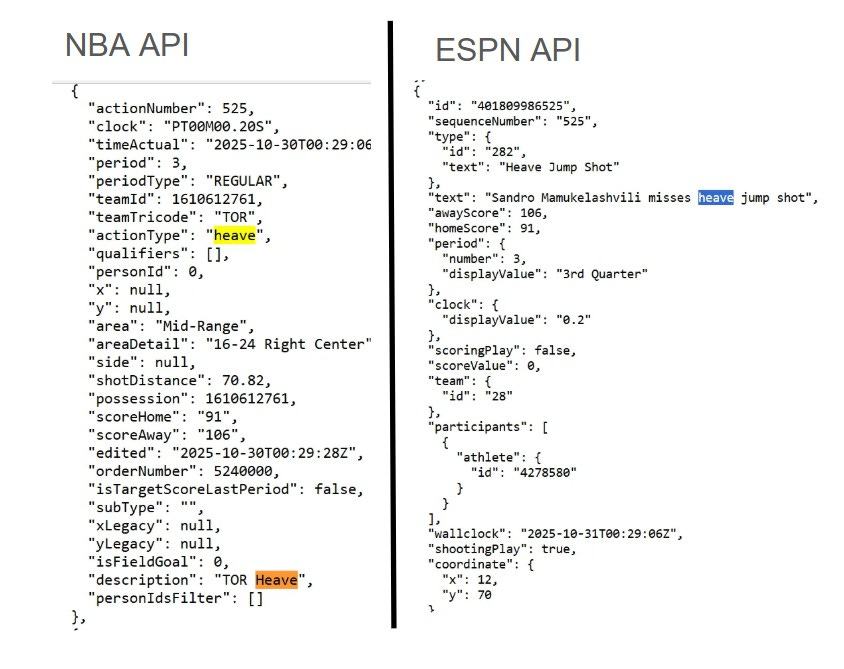
On NBA.com, the API shows “TOR Heave.” No one is responsible for the 70.82 feet at the third-quarter buzzer. Erasure!
But luckily, there’s The Worldwide Leader in Sports. ESPN’s API goes deeper — that’s where you’ll find that the TOR Heave from sequence 525 belongs to none other than Georgian-American center Sandro Mamukelashvili. This is your unlock.
So, you spend weeks learning about APIs, JSONs, and cron triggers. You discover the NBA’s advanced stats site attaches video to every Game Event (well, most of them).1
You install some questionable programs to your vibe coding environment and figure out how to convert those videos into YouTube compilations — Don’t Stop the Heavin’ — that nobody watches.
By season’s end, your Heave Detection System is finally in place, running on its own. It’s a Saturday morning in April and most every team is either tanking or resting their stars. You check your heave website — you’re one of two visitors that day — and open the April 10 daily heave report revealing a record-setting 17 heaves.
That’s one more than the sweet 16 notched twice earlier in the season and once 15 years ago.2
Everything you’ve been working for has been worth it.
🧱🧱 🏀 🧱🧱
Brand New Heavers
Before the rule change, an end-of-quarter sequence might go something like this: Kevin Durant accepts an inbounds with three seconds left. Takes a few dribbles. Then just after the clock expires, he launches the prayer. It doesn’t count.3 Durant has plausible deniability and preserves his percentages.
The new rule changed the incentives. Now, players are hoarding heaves. Luka Doncic led the league with a career-high 23 attempts (zero makes). Jalen Brunson and Ayo Dosunmu heaved 12 times this season, which is 12 more than in 2024-25. Across the league, players are heaving more often and from further out.
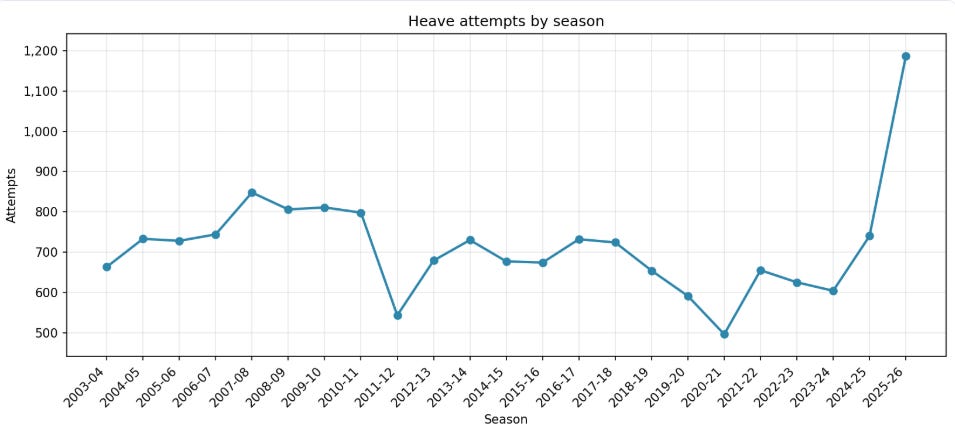
The 2025-26 season shattered the record for most attempts from 36+ feet with 1,180, or nearly one per game.4
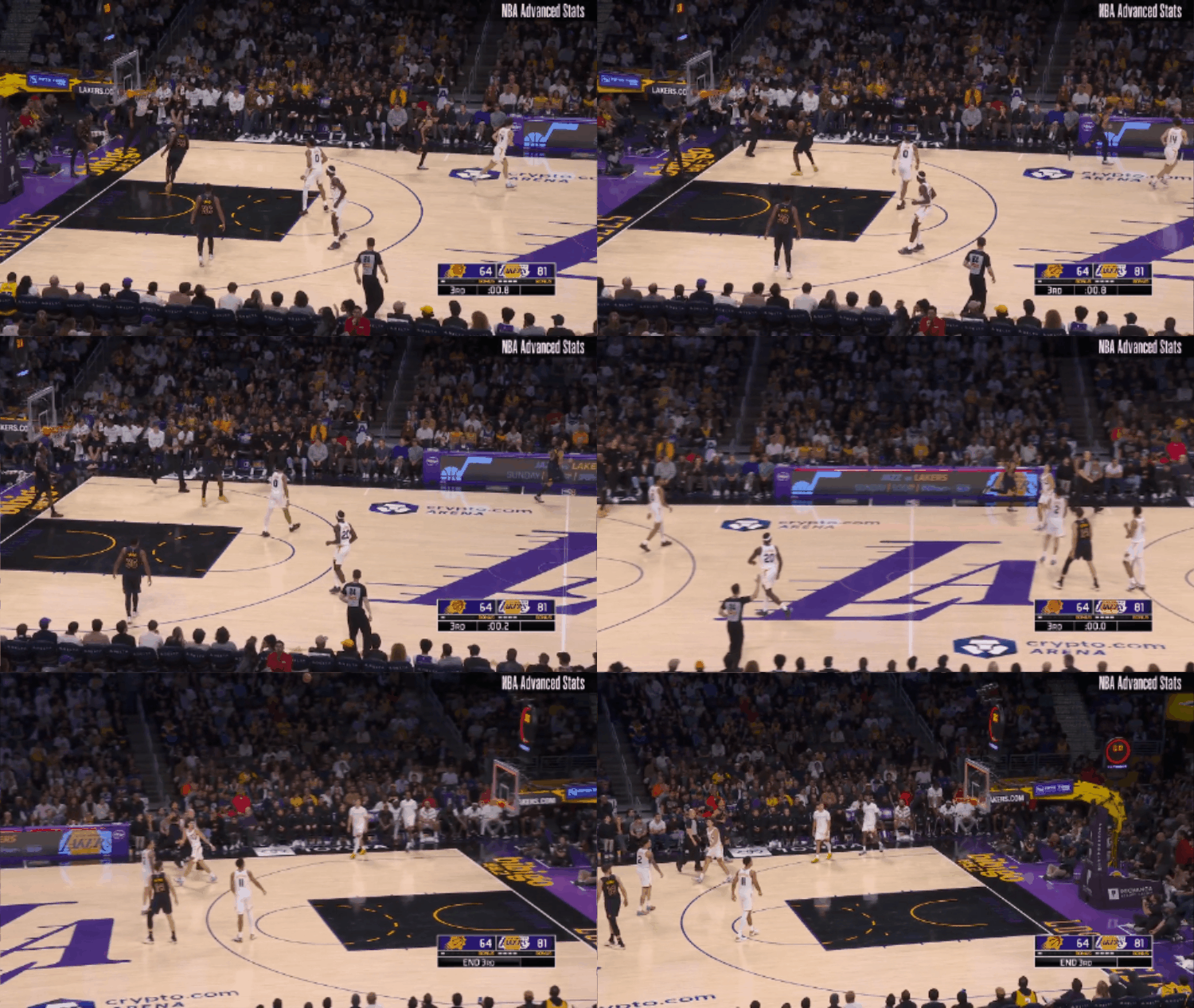
I’ve watched nearly all of them, from Kon Knueppel’s headshot triple to LeBron’s 81-foot Hail Mary — “Look out, first row” — that was the record-setting 17th heave on April 10. The new NBA rule is working just as Lord Silver intended.
Heaves are good, in a vacuum. But basketball is a zero-sum game. More shots for the heave cowards means less for the heave heroes like Payton Pritchard, who would take the bloody shot, percentages be damned. Less for Nikola Jokic, who kept on shooting (and occasionally making) even though his brother told him not to.5
Those players — and the teams who employ those players — ought to be rewarded for their bravery. And these glorious shots ought to be remembered. Instead, the NBA leveled the playing field by bailing out the cowards and erasing history.6 Or tried to, at least.
🧱🧱 🏀 🧱🧱
I Think You Should Heave
NBA basketball is art. World-class athletes, a foot taller than us, glide and fly in unimaginable ways, all while possessing the ability to throw a round object into a small cylinder from 20+ feet away.
So skilled are these giants that we expect every shot, regardless of distance or positioning, to land precisely on its intended target. Shots that hit the wrong part of the rim — only inches off target — are memed. Swishes are merely approved.
Heaves are exempted from expectation. From long distance, players are granted permission to miss—and miss miserably. So long as they grant permission to themselves.
I’m the youngest of three boys from a family that loves shooting basketballs, maybe more than basketball itself. And so, I spent my formative basketball years blocked out of the paint and being chased outside the three-point arc. When I picked up my dribble, I had one choice: Heave it or Leave it.
And so, time and again, I launched. Sometimes it fell short. Sometimes it flew over the backboard a la Carlton Banks in Courting Disaster. Sometimes it clanked off the rim. And on rare occasions, it went in.
I didn’t amount to much as a basketball player, though not for fear of shooting. Those in the Main Line might recall the famous 2007 Friends’ Central tryout7 where I tried sandbagging my way to Third Team by launching — and inadvertently making — a handful of ill-advised four-pointers. The coaches then moved Mustafa Shakur 2.0 over to the varsity court where the magic continued. The rest is history.8
Most basketball shots can go one of only a few ways: make it, miss by a little, miss by a little more. The heave is the exception.
When a high-arching prayer even threatens the cylinder, everything stops. Arenas fill early just to watch Stephen Curry warm up from distances that shouldn’t exist. LeBron once ditched his teammates to tackle a stranger who hit a halftime halfcourt shot for $75,000. Michael Jordan once bullied an insurance company to pay up on a fan’s $1 million half-court shot prize after they attempted to back out on a technicality. My eyes are glued to League Pass when Franklin the Dog fires backwards during TV timeouts.
Each heave tells a story. That’s why the misses — Joel Embiid’s full-court miracle rimming out against the Suns, Gordon Hayward’s half-court shot that nearly landed Butler a national title, my driveway heaves that broke the Rutstein’s fence — must not be forgotten.
Box scores are temporary. But the Heave Report is here to ensure that bricks are forever. Don’t stop the heavin’, wherever you are. You shouldn’t need a rule change for permission.
Missed heave videos are routinely “unavailable” on the NBA site. I guess they stop recording at the end of the quarters.

The April 13, 2011 heavers included Stephen Curry, DeMar DeRozan, Jrue Holiday, Chuck Hayes, Jason Terry, and Willie Green.
Though this delayed Durant heave actually went in. Karma!
NBA players made 31 heaves this season, similar to prior seasons. Though that’s partly because of injuries to 4-point specialists Trae Young, Stephen Curry, and Damian Lillard. Those three are the top “lite heavers” with a combined 43 career makes between 36+ feet and halfcourt.
Jokic’s 3-point percentage dropped almost 3% last season because of heaves (he was 3 of 27) though his offensive efficiency was still okay. He also shot 13 fewer heaves this season. Some went to Jamal Murray, who made a league-high three halfcourt shots in just nine attempts.
The new rule also bails out lazy front office decision-makers. Those who offer shooting percentage-based incentives — Maurice Harkless once stopped shooting 3-pointers so he could stay above the 35% bonus threshold — deserve the chaos that follows.
Okay, fine, like a dozen high school classmates.
I went 1-11 in my first two junior varsity games before getting benched and retiring midseason.